Kung Fu Soccer
A 2004 Hong Kong, China television drama that fused martial-arts comedy with football, built around a kick-based fighting style and an unlikely team assembled to challenge a corrupt sporting establishment.

At a glance
- Original title
- 功夫足球
- Year
- 2004
- Origin
- Hong Kong, China
- Format
- Television drama series
- Episodes
- 25 (some databases list 33)
- First broadcast
- 6 December 2004, TVB
- Language
- Cantonese
- Genre
- Sports comedy, martial arts, drama
- IMDb
- tt0439940
Overview
Kung Fu Soccer (Chinese: 功夫足球; Gung Fu Juk Kau) is a 2004 television production from Hong Kong, China. It tells the story of a football devotee who discovers a martial artist with an extraordinary kicking technique and builds a team around him, hoping to challenge the people who ruined his own career. The premise places classic Hong Kong martial-arts comedy inside the world of competitive football, with training montages, underdog matches and a villainous sporting establishment.
The lead role of the kung fu prodigy was played by Dicky Cheung, a performer well known to Cantonese-speaking audiences for energetic comic roles and for singing the series' theme music. Sandra Ng played his sister, and the cast included Anthony Wong, Bowie Lam, Chapman To, Charlene Choi, Gillian Chung, Jerry Lamb, Natalie Ng, Yoyo Mung, Rain Li and Wong Yat-fei. The series was first broadcast by TVB from 6 December 2004, airing on weekday evenings at 20:00 Hong Kong time.
The programme is frequently catalogued as a film in international databases, which is why it is often discussed alongside movie titles. In its place of origin it is a television drama, and its structure — an ensemble, a season-long arc and recurring match episodes — reflects that format. This guide treats it as a television production while using the "movie" label that many catalogues and fan sites have adopted.
"The series is regarded as a television version of Shaolin Soccer, and during its broadcast audiences frequently compared the two." — Production note, Chinese Wikipedia
Format and broadcast history
Chinese-language sources describe Kung Fu Soccer as a 25-episode drama acquired and broadcast by TVB. International databases are less consistent: TMDB lists a longer episode count, and the title appears in film catalogues as well as television listings. The disagreement is typical of older Hong Kong, China productions that circulated through several markets under different packaging. For viewers, the important point is that the story was designed to unfold over a season rather than in a single sitting.
The original run began on 6 December 2004 and continued through the weekday evening schedule. A repeat was broadcast on Saturday afternoons between 14 October 2006 and 14 April 2007, and the series later appeared on TVB's drama channel from 15 May 2007. These repeats mattered: for a generation of viewers, the programme was discovered years after its first run, at a time when Hong Kong, China television comedies were widely syndicated across Chinese-speaking communities.
The series was produced in Cantonese and circulated under the same English title in a number of markets, including Australia, Canada, the United Kingdom, Ireland, India, New Zealand, the United States and South Africa. Its Chinese title, 功夫足球, is literally "kung fu football", a compact description of the hybrid premise. The English title uses "soccer" to distinguish the sport from other codes of football for international audiences.
Because the show was made for television, its pacing differs from a feature film. Episodes build towards fixtures, training sequences and revelations about characters' pasts, then resolve immediate conflicts while leaving the larger league storyline open. That rhythm explains both its cult following and the criticism that its repetition could feel stretched when compared with a tightly edited movie.
The world the series came from
To understand why Kung Fu Soccer looks and sounds the way it does, it helps to place it in the television industry that produced it. In the early 2000s, Hong Kong, China television comedy operated with a set of conventions quite different from the single-camera sitcoms familiar to British and American audiences. Productions were shot quickly, often on a mix of studio sets and location work, with a large rotating cast and an emphasis on visual gags that could be understood across language barriers. A series could be comic in one scene, melodramatic in the next and physically spectacular in the third without any sense of tonal contradiction.
The football premise arrived at a moment when international club football had become a major visual presence in the region. European team colours, badges and sponsorship were recognisable to audiences who followed the sport through television highlights rather than through local leagues. The decision to model the fictional team's crest on Manchester United's badge depended on that familiarity: the joke was not simply that the team was ambitious, but that its ambitions were expressed in the visual language of a global club brand. At the same time, the series insisted that the sport could be reinvented through a local martial tradition. Those two impulses — global reference points and local technique — sit side by side throughout the programme.
The cast reflected the same mixture. Dicky Cheung was a television and music star whose energetic comic persona had been built over many years. Sandra Ng brought a tradition of broad, physical comedy that made her a natural counterpart. Anthony Wong and Bowie Lam added dramatic weight, while performers such as Charlene Choi and Gillian Chung connected the production to the contemporary Cantopop audience. A series of this kind was designed so that different viewers could arrive through different doors: through a favourite actor, a singer, a comic performer or simply the promise of an unusual sports premise.
Music reinforced that design. The opening theme connected the new drama to Captain Tsubasa, an anime whose Hong Kong, China broadcast had made its theme song familiar to a generation. In reusing the melody with new sports-oriented lyrics, the production drew on an existing emotional association with football, childhood and improbable victory. Viewers did not need to be told what kind of story they were watching; the first few bars told them. This is a useful reminder that television comedy of the period relied heavily on shared cultural memory rather than on exposition.
Finally, the format itself shaped the humour. A twenty-five-episode run needs recurring situations, and the series therefore returns constantly to training, selection, arguments within the team and public matches. Those repetitions are not accidental padding; they are the mechanism by which an ensemble becomes a group. A film has ninety minutes to convince the audience that a team has formed. A television series can spend weeks on the process, letting small misunderstandings and small loyalties accumulate until the final matches carry emotional weight.
Story and characters
The founding idea
Available synopses agree on the basic setup. A father is cheated into signing modelling contracts for his children, while in the main storyline a martial artist named Tong Siu-shun lives under the care of his sister Tong Daai-shun. He is described in catalogue summaries as a fighting prodigy with a dissociative or absent-minded condition, trained from childhood in the family's tan tui kicking art.
Alongside him is Lam Chung-foo, a former footballer whose career was destroyed by people around the game. His ambition is not merely to win a trophy but to "develop Chinese football" — to prove that the sport can be transformed from within. When he witnesses the brother and sister using their kicking techniques, he sees a possibility no coach has considered: combining traditional martial arts with football technique. Persuading the sister to let her brother join takes time, and that negotiation forms the emotional core of the setup.
Assembling the team
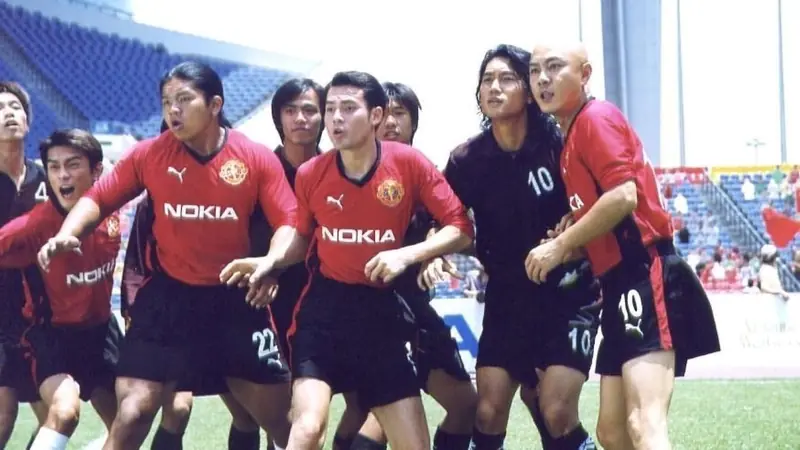
The series follows the creation of an unlikely squad. Players arrive with different motivations: some are childhood friends, some are recruited from ordinary jobs, and some are drawn by the promise of a coach who understands what they can do. Lam's own history gives the team its purpose. He knows how easily a player can be discarded by officials and club owners, so his methods are shaped by resentment as much as by tactical insight.
The martial-arts element is not presented as magic. Characters train, practise drills and adapt their existing skills to the dimensions of a pitch. The early promise of the premise — that a kung fu kick could change a match — is gradually grounded in the practical problems of teamwork, stamina and rules. That progress from comic idea to working method is what gives the series its structure.
The opposition
The antagonists are drawn from the business and administration of the sport: club owners and officials with influence over leagues and selections. This choice links the personal grievance of the coach to a wider institutional critique. The heroes are not simply trying to beat a better team; they are trying to beat a system that decided in advance which players were allowed to matter.
That structure gives the series its characteristic tone. Matches are not just athletic contests but public verdicts on the people running the game. When the underdogs succeed, the victory is framed as a correction to an injustice rather than a sporting upset. Reading the series in this way makes sense of its long running time and its repeated training and preparation beats: the point is that the system has to be challenged consistently, not defeated once.
How the story works
The narrative of Kung Fu Soccer is built on a repeating pattern: an idea is proposed, tested in practice, mocked by established professionals and then proved in public. That pattern can operate inside a single episode or across several, and it is the main reason the series feels both episodic and cumulative. Understanding it makes the long runtime easier to navigate, because the apparent repetition is doing structural work rather than simply delaying the next match.
Discovery and persuasion
The first movement of any arc involves someone noticing an ability that others have overlooked. Lam Chung-foo sees the kung fu team's potential before anyone else does, and the persuasion that follows is a recurring device: the sister must be convinced, the players must be convinced, and the football world must eventually be forced to acknowledge what they can do. Each act of persuasion is dramatised as a small contest of wills, usually with comic consequences when an ordinary person misunderstands what a martial artist can do with a ball.
Training as comedy
Training sequences are the programme's most distinctive repeated element. Because the fighting style is kicking-based, a drill can be staged as a martial-arts exercise and as a football practice at the same time. The comedy comes from the gap between the seriousness of the training language and the absurdity of the setting. A performer may be asked to treat a defensive wall as a sparring partner, or to approach a free kick as a form challenge. The best of these sequences work because the physical skill is real enough to be impressive while the context remains ridiculous.
The public test
Each promising idea is eventually taken into a match. The public test is where the series pays off its preparation, and it is staged with a clear grammar: the opposition begins with confidence, the unusual method initially looks chaotic, a setback suggests the experiment has failed, and then a controlled use of the martial technique changes the result. Because the formula is visible, the pleasure comes from variation rather than surprise. Different episodes change the setting, the opponent and the specific technique on display.
Institutional consequence
What separates the series from a simple sports comedy is that victories have administrative consequences. A win changes selection decisions, threatens a club owner's authority or forces officials to acknowledge the team. The story therefore treats sport as a political arena. This is where the coach's backstory matters most: his grievance is not personal vanity but a belief that the institutions excluded him and people like him. Each result is a small act of restoration.
Read together, these four movements explain the programme's pacing. It is not a story that rushes towards a single trophy; it is a story about making an alternative method legible to a system that has no category for it. That is why the series spends so much time on explanation and so little on the private lives of the players outside the team. The team itself is the family, the workplace and the political vehicle at once.
Cast and characters
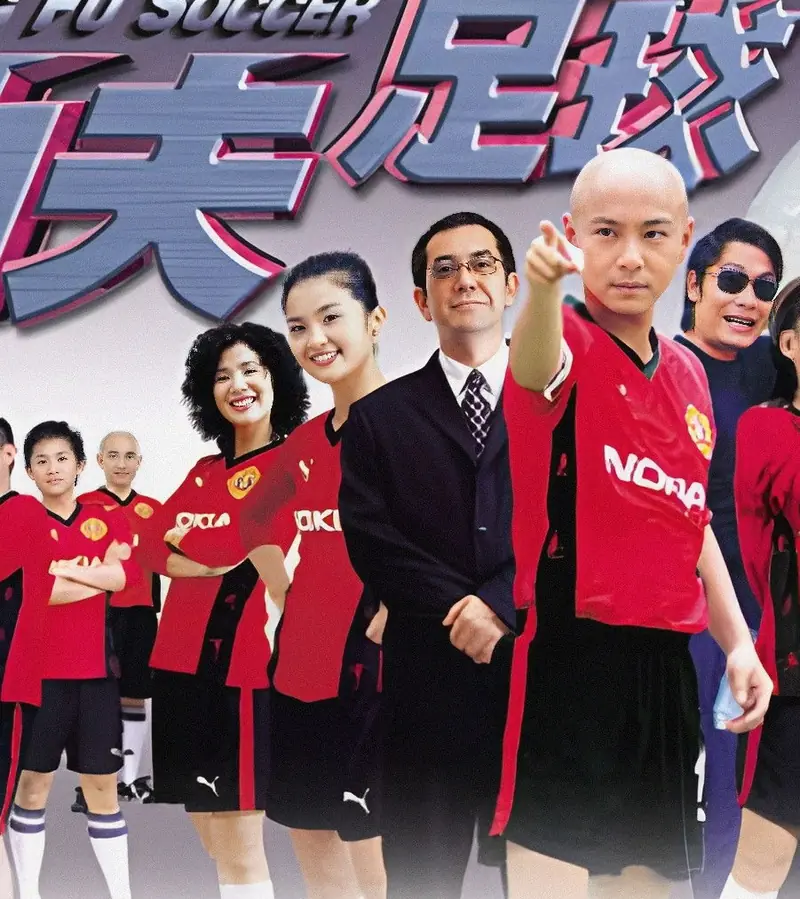
The production used a large ensemble typical of Hong Kong, China television drama, mixing established film performers with actors and singers from the local music industry. Cast lists vary between databases, so the table below includes the roles that can be stated with reasonable confidence and notes where a performer is known principally from the ensemble.
| Performer | Character / role | Note |
|---|---|---|
| Dicky Cheung | Tong Siu-shun | Lead martial artist; also performed the theme music. |
| Sandra Ng | Tong Daai-shun | His sister and guardian, trained in the same family art. |
| Bowie Lam | Lam Chung-foo / coach figure | The former player who proposes combining kung fu and football. |
| Anthony Wong | Senior figure in the football world | Credited among the principal cast in international listings. |
| Chapman To | Team member / comic relief | Credited among the principal cast. |
| Charlene Choi | Ensemble role | Singer and actress, credited in cast listings. |
| Gillian Chung | Ensemble role | Singer and actress, credited in cast listings. |
| Jerry Lamb | Ensemble role | Credited among the principal cast. |
| Natalie Ng | Ensemble role | Credited among the principal cast. |
| Yoyo Mung | Ensemble role | Credited among the principal cast. |
| Rain Li | Ensemble role | Credited among the principal cast. |
| Wong Yat-fei | Kung fu team member | Also appeared in Shaolin Soccer, using a similar iron-head gag. |
| Anson Leung | Ensemble role | Credited among the principal cast. |
Cast lists published by different databases do not agree on every name or character spelling, and several roles were ensemble parts rather than named leads. The production is best understood as a star vehicle for Cheung supported by a broad comic and dramatic roster. That structure is typical of the format: a television series needs enough recognizable faces to sustain twenty-five episodes, and cameo appearances were part of the appeal.
The performers in context
Dicky Cheung's position as the lead explains much of the series' tone. His screen persona was built on speed, physical comedy and an ability to play competence and absurdity at the same time — qualities that suit a character who is extraordinary at one specific thing and out of place everywhere else. He also sang the opening and closing themes, which was common for television stars in the region and gave the production a single, recognisable voice across music and story.
Sandra Ng's role as the sister provided a different comic register. Her work in Hong Kong, China comedy often depends on directness and an impatience with pretension, which made her a natural guardian for a brother whose abilities invite exploitation. The sibling pairing therefore carries two kinds of humour: his takes pleasure in the fantastic skill, while hers punctures the grandeur of everyone trying to use it.
Anthony Wong and Bowie Lam brought the dramatic counterweight. Both performers were associated with serious roles, and their presence signals that the series intends its institutional villains and its coach's history to be taken at least partly straight. That balance matters in a programme whose title promises comic fighting and whose story is about a man whose life was ruined by the sport he loved. Without performers able to hold the darker material, the premise would collapse into a sequence of gags.
The younger ensemble, including Charlene Choi, Gillian Chung, Jerry Lamb, Natalie Ng, Yoyo Mung and Anson Leung, widened the show's appeal. Several were known as singers as well as actors, at a time when crossovers between Cantopop and television drama were routine. Their roles gave the team a generational texture: the older characters carry grudges and histories, while the younger ones treat the enterprise as an adventure. The contrast allows the series to argue that reinvention requires both memory and youth.
Wong Yat-fei occupies a special place in the cast. His appearance links the production directly to Shaolin Soccer, because he used a comparable iron-head speciality in both. For viewers who noticed, the recurrence was a piece of knowing casting that placed the television series inside a shared comic universe without claiming any formal connection. It is exactly the kind of detail that helps explain why audience discussion of the programme so often returns to the earlier film.
Catalogue problems and missing credits
One of the difficulties of writing about Kung Fu Soccer outside its original market is the state of the available documentation. International databases disagree about its format, its episode count and even the people responsible for directing and writing it. GoldPoster, TMDB and IMDb each carry different fragments, and fields that would be routine for an American or British production are simply blank. This is not unusual for regional television from the period: credits were published locally, often only in Chinese, and were not systematically translated.
The consequences are practical. A search for the title may surface a film catalogue entry, a television entry and a set of episode records that appear to describe different works. Character names are romanised in several ways, and some performers are credited under English names while others appear only in Chinese. Anyone trying to reconstruct the production history has to treat individual databases as partial sources rather than authorities.
This guide has therefore limited itself to claims that can be supported by more than one accessible source, or that come from local-language summaries of the broadcast. Where sources disagree — most obviously on the number of episodes — the disagreement is stated rather than resolved. That approach is more honest than choosing a convenient figure, and it reflects the reality that a great deal of the programme's history exists only in its original broadcast context.
The same caution applies to the comparison with Shaolin Soccer. Chinese-language sources explicitly say that viewers compared the two and list the shared devices; that is a documented reception fact. It does not establish that the series was an official adaptation, a licensed spin-off or a deliberate imitation. The fair description is that it worked in a genre the earlier film had defined for international audiences, with several deliberate echoes that contemporary viewers were quick to identify.
Production and visual style
Development and filming
The series was made in 2004 and filmed largely in Guangzhou on the Chinese mainland, a point that Chinese-language sources explicitly note when comparing it to Shaolin Soccer, which was also shot there. The location gave the football sequences access to real stadiums and large crowds, and the production used those spaces as more than background. Stands, floodlights and pitch boundaries recur as visual motifs, reinforcing the idea that the characters' private ambitions are being played out in public.
Few detailed production credits are available in English-language catalogues. Director and writer fields are frequently left blank in international databases, a common problem for regional television productions whose credits were never systematically translated. What is clear from the finished programme is the hand of a television comedy tradition: studio-bound character scenes alternate with location shoots, and the action is staged for the small screen with clear framing rather than rapid cutting.
Action design
The fighting style at the centre of the series is tan tui, a northern Chinese kicking art known for direct, low and fast leg techniques. Choosing a kicking-based style was a practical piece of adaptation: it allowed choreography to look like football technique without requiring the performers to abandon their martial-arts vocabulary. The result is a sequence of visual rhymes — a training kick becomes a pass, a sweep becomes a tackle, a leap becomes a header.
Wong Yat-fei's iron-head routine provides the series' most explicit link to Shaolin Soccer. In both productions his character uses a hardened skull as a speciality, a gag that translates neatly into football action. The fact that the same performer appears in both gives the comparison more than a thematic basis; it is a piece of casting continuity that audiences in 2004 noticed immediately.
Music
Music played an unusually visible role in the series. The Cantonese opening theme, 足球小将, was performed by Dicky Cheung, with 比赛 used as the Mandarin version. The Cantonese ending theme was 大奖, again performed by Cheung, with 不是你的错 as its Mandarin counterpart. Insert songs included 贪慕虚荣 performed by Joey Yung and 分秒必争 performed by Gary Chaw.
The opening theme had a second life. It was a Cantonese adaptation of the theme used for a season of the Japanese anime Captain Tsubasa when that series was broadcast in Hong Kong, China, and it had also been sung by Cheung. For local audiences, the melody already meant football, childhood and heroic underdogs before the new drama began. Reusing it gave the programme an immediate emotional shorthand and connected it to a longer history of sports animation in the region.
Comparison with Shaolin Soccer
It is impossible to discuss Kung Fu Soccer without addressing the film it was constantly compared with. Stephen Chow's Shaolin Soccer (2001) had taken a similar premise — martial artists applying their skills to football — and turned it into one of the biggest hits in the history of Hong Kong, China cinema. Chinese-language sources describing the 2004 series state plainly that it was seen as a television version of that film, and audiences compared them throughout the broadcast.
The similarities are specific. Both leads rely on kicking techniques rather than hand-based styles: Shaolin Soccer uses the "Mighty Buddha's Leg" while this series uses tan tui. Both include Wong Yat-fei performing an iron-head speciality. Both were filmed in Guangzhou. Both pit a group of underestimated players against club owners and officials with ties to the football establishment. And in both, the coach was once a celebrated player whose career was destroyed by rivals, which gives the victory plot a personal dimension.
The differences are equally important. Shaolin Soccer is a feature film built around rapid escalation and spectacular visual effects; Kung Fu Soccer is a serial drama built around recurring fixtures and character development. The film's comedy is dominated by Chow's singular performance, while the series distributes comic duties across a large ensemble. The film used computer-generated appearances by famous players as punchlines; the series also featured Ronaldo, Zidane and Beckham as computer effects rather than live performers, a detail specifically noted in Chinese-language sources.
The team crest provides a small but revealing point of contact. In the series, the kung fu team's badge was modelled on Manchester United's crest, grounding the fiction in the visual language of real European club football. That choice reflects the period: early-2000s Hong Kong, China sports comedy assumed an audience familiar with international club branding, and the joke depended on recognising it.
Comparisons were not always favourable. A television budget could not match the scale of a theatrical release, and a twenty-five-episode structure inevitably repeated beats that a ninety-minute film would compress. Yet the comparison also gave the series an audience. Viewers drawn by the promise of a similar comic sports hybrid found a longer, more character-driven version of the idea, and the programme's cult reputation rests largely on that trade-off.
Themes and analysis
Tradition as a competitive advantage
The central fantasy is that an older physical tradition can solve a modern problem. Martial arts in the series are not presented as museum pieces; they are treated as a set of techniques that have been overlooked by people who think football can only be played one way. That idea is characteristic of Hong Kong, China popular cinema, where traditional practices are often re-tested against modern institutions and found to be unexpectedly useful.
The corrupted institution
The villains are administrators rather than opposing athletes. This matters because it changes the moral geometry of the story. Beating another team would only prove that the heroes can play; beating the people who control selection and sponsorship proves that their exclusion was wrong. The series uses this structure to convert sports entertainment into a story about fairness, patronage and who gets to define talent.
Family and guardianship
The relationship between the two siblings gives the comedy an emotional anchor. The sister is not merely a comic foil; she is the person who decides whether the experiment can happen at all. Her caution is reasonable, because the coach's plan asks her brother to risk public humiliation in a sport that has already harmed him indirectly. The series therefore frames trust as a decision made within a family before it becomes a decision within a team.
Underdog spectacle
At its simplest, the programme is a sequence of underdog victories. Each match asks whether an unconventional method can survive contact with professional expectations. The answer is usually yes, but the repetition is deliberate: a single upset could be dismissed as luck, while a season of results becomes an argument. The format allows the series to make that argument patiently in a way a film cannot.
Why it is still watched
For a production that has been off the air for nearly two decades, Kung Fu Soccer retains a surprisingly durable audience. The first reason is simple novelty: there are very few works that attempt to combine a complete martial-arts vocabulary with the rules of association football. Even when a training sequence is implausible, the attempt to make the two systems talk to each other is genuinely distinctive. Viewers who enjoy genre hybrids find something here that later productions have rarely repeated.
The second reason is the ensemble. Because the series has time to spend with its players, the team becomes familiar in a way that a film's supporting cast cannot. Returning viewers often speak about individual characters and their running jokes rather than about the league plot. That is a mark of the format working as intended: the serial structure creates attachments that a single match could not sustain.
The third reason is familiarity of a different kind. For audiences who grew up with the repeat broadcasts or with the Captain Tsubasa theme, the programme is part of a personal map of television in Hong Kong, China. Watching it again is as much about recovering a period as about evaluating a drama. This explain why its reputation has outlasted the amount of critical writing about it: the show lives in memory rather than in archives.
Reception and legacy
Contemporary critical coverage of the series is limited in English, and international databases record few formal reviews. Its reputation has instead been built through audience memory, repeat broadcasts and online discussion. Within Cantonese-speaking communities it remains a recognisable title from the mid-2000s, frequently mentioned in conversations about television comedies that attempted large-scale sports storytelling.
The show's afterlife has been shaped by the comparison with Shaolin Soccer. For some viewers, that comparison is a limitation: the series is remembered as a smaller echo of a better-known film. For others, the longer format is precisely the attraction, because it gives the ensemble time to develop and allows the kung fu-football idea to be explored in more than one match. Both readings are supported by the structure of the programme itself.
The series also illustrates a broader moment in Hong Kong, China television, when productions were made for a local audience but circulated internationally through catalogues that did not always distinguish television from film. That is why a twenty-five-episode drama now appears in movie databases under the same title as a feature. For researchers and fans, the practical lesson is to check the original broadcast details before treating catalogue metadata as authoritative.
A typographic recreation of the key art
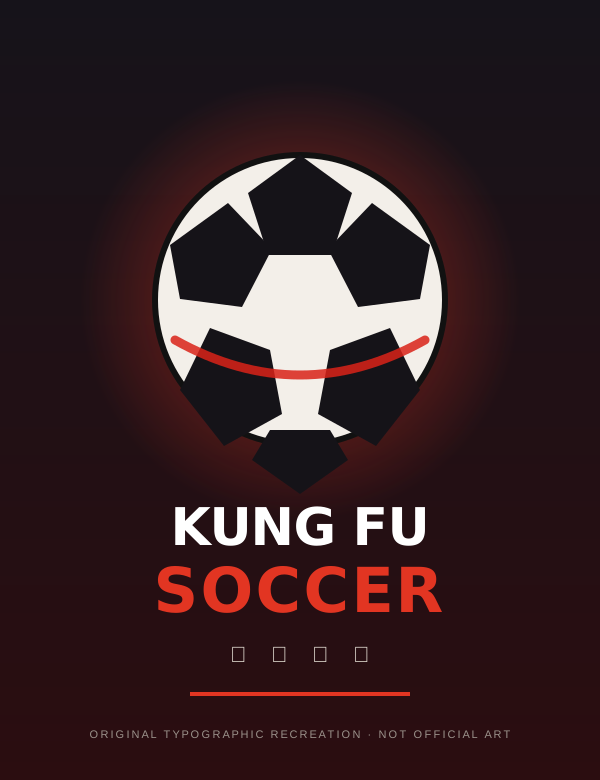
Alongside the promotional imagery, this guide includes an original text-based reinterpretation of the series' visual identity. It reduces the football to a set of angular red and black panels and pairs the English title with the Chinese characters 功夫足球. It is offered as commentary, not as official artwork.
Frequently asked questions
Is Kung Fu Soccer a film or a TV series?
It is a 2004 television drama from Hong Kong, China, first broadcast by TVB. Some international databases catalogue it as a film, which is why the "movie" label is often used.
When did it first air?
The original broadcast began on 6 December 2004 on TVB, in the weekday 20:00 slot in Hong Kong time.
How many episodes are there?
Chinese-language sources describe 25 episodes. TMDB lists a longer count, so catalogue figures differ.
Who stars in it?
Dicky Cheung leads, with Sandra Ng, Anthony Wong, Bowie Lam, Charlene Choi, Gillian Chung, Chapman To and a large ensemble cast.
Is it related to Shaolin Soccer?
Not officially, but it was widely compared with Stephen Chow's 2001 film. Both use kicking-based martial arts, Guangzhou locations, a ruined former player as coach, and Wong Yat-fei's iron-head routine.
What is the fighting style used?
The heroes use tan tui, a northern Chinese kicking art adapted into football technique for the series.
Sources and external links
- IMDb — Kung Fu Soccer (tt0439940): catalogue and cast credits.
- Chinese Wikipedia — 功夫足球: broadcast history, music and comparison notes.
- TMDB — Kung Fu Soccer: series metadata and original artwork.
- GoldPoster — Kung Fu Soccer: cast list and release date.
- 1905 Movie Network — 功夫足球: synopsis and production credits.
This page is an independent, informational fan guide. Kung Fu Soccer and all related marks are trademarks of their respective owners. Promotional images are used for identification and commentary.
Reader discussion
Comments appear live. Your name links to your website; links are marked
nofollow. Basic HTML is allowed in comments.Comments
No comments yet. Be the first.